Understanding Export and Import Documents in Indonesia
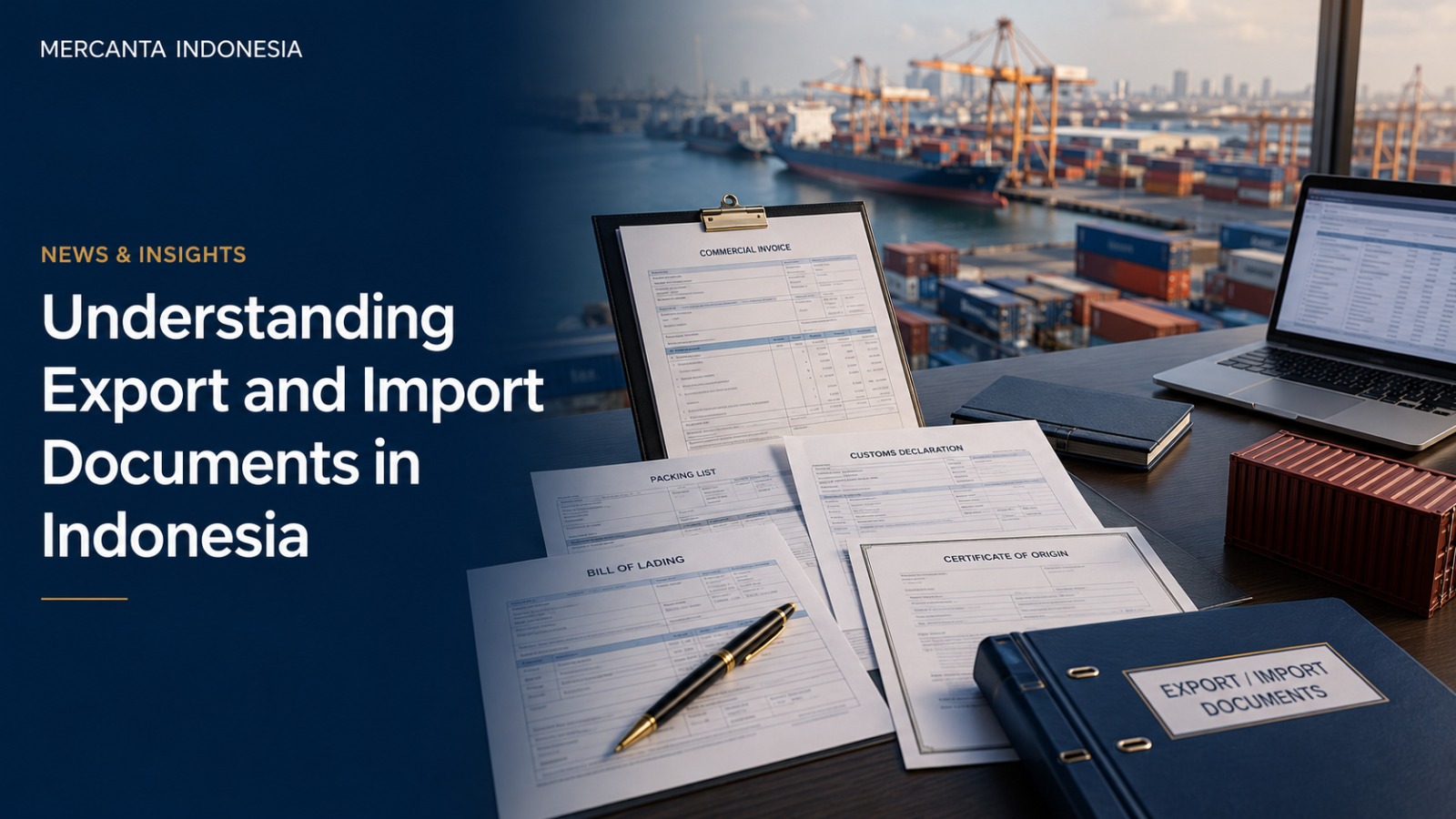
Essential guide to key trade documents in Indonesia—from Commercial Invoices to Certificates of Origin—ensuring smooth customs clearance and regulatory compliance.
International trade offers significant opportunities for businesses seeking to expand their markets, source competitive products, and build global partnerships. However, every export and import transaction must be supported by accurate and complete documentation.
In Indonesia, trade documents are used to identify the goods, determine their customs value, calculate applicable duties and taxes, confirm their country of origin, and ensure compliance with national and international regulations.
Incomplete or inconsistent documentation can result in customs delays, additional costs, rejection of preferential tariffs, or even the detention of goods. Therefore, exporters, importers, suppliers, and international buyers should understand the primary documents required in a cross-border transaction.
1. Commercial Invoice
A commercial invoice is one of the most important documents in international trade. It is issued by the seller or exporter to the buyer and serves as the official record of the transaction.
A commercial invoice normally includes:
• Seller and buyer information • Invoice number and date • Description of the goods • Quantity and unit price • Total transaction value • Currency • Country of origin • Harmonized System—or HS—code • Payment terms • Delivery terms or Incoterms • Shipping information
Customs authorities use the commercial invoice to assess the value of the goods and calculate duties and taxes. All information must be consistent with the packing list, transport document, customs declaration, and sales agreement.
2. Packing List
A packing list provides detailed information about how the goods are packed for shipment. Unlike the commercial invoice, it focuses on the physical details of the cargo rather than its financial value.
A packing list generally contains:
• Number and type of packages • Product description • Quantity per package • Net and gross weight • Package dimensions • Marks and package numbers • Container number, when applicable • Total shipment volume
Freight forwarders, customs officers, warehouse operators, and buyers use this document to identify and inspect the cargo. Accurate packing information also helps prevent mistakes during loading, unloading, and delivery.
3. Export Declaration (PEB)
The Export Declaration, known in Indonesia as Pemberitahuan Ekspor Barang or PEB, is a customs declaration submitted for goods being exported from Indonesia.
The declaration contains information such as:
• Exporter’s identity • Buyer or consignee • Description and classification of goods • HS code • Quantity and weight • Export value • Country of destination • Port of loading • Transportation details • Supporting licenses or certificates, when required
The information submitted in the PEB must match the commercial invoice, packing list, and transportation documents.
Certain products may be subject to export restrictions, special reporting requirements, inspections, export duties, or technical recommendations. Businesses should verify the current requirements before shipping their goods.
4. Import Declaration (PIB)
The Import Declaration, or Pemberitahuan Impor Barang (PIB), is submitted to Indonesian Customs for goods entering Indonesia.
The PIB normally includes:
• Importer’s identity • Supplier or exporter information • Product description • HS code • Country of origin • Customs value • Quantity and weight • Port of entry • Freight and insurance information • Import duties and taxes • Import licenses or approvals, when applicable
The PIB is used to assess customs duties, import taxes, and regulatory compliance. Incorrect product classification or customs valuation may cause delays, financial penalties, or reassessment by the authorities.
Importers should determine whether the goods are freely importable, restricted, or subject to specific technical requirements before placing an order.
5. Bill of Lading
A Bill of Lading, commonly abbreviated as B/L, is issued by a shipping line or carrier for goods transported by sea.
It generally performs three important functions:
1. It serves as evidence that the carrier has received the goods. 2. It records the terms of transportation. 3. In certain forms, it functions as a document of title to the goods.
A Bill of Lading usually contains:
• Shipper’s name • Consignee’s name • Notify party • Port of loading • Port of discharge • Vessel and voyage information • Container and seal numbers • Description of goods • Number of packages • Gross weight and volume • Freight terms
The names, cargo details, and shipping information must be consistent with the commercial invoice, packing list, and customs declaration.
For air shipments, the equivalent transport document is an Air Waybill. Unlike certain Bills of Lading, an Air Waybill is generally not treated as a negotiable document of title.
6. Certificate of Origin
A Certificate of Origin confirms the country in which the goods were produced or manufactured. In Indonesia, this document is commonly associated with the Surat Keterangan Asal or SKA.
A Certificate of Origin may be required to:
• Confirm the origin of a product • Meet the destination country’s import requirements • Support customs clearance • Claim preferential tariffs under a trade agreement • Fulfil contractual requirements from the buyer
To receive preferential tariffs, the goods must comply with the relevant rules of origin. Merely shipping a product from Indonesia does not automatically make it eligible for preferential treatment.
The exporter must ensure that the product qualification, HS code, supporting records, and certificate format comply with the applicable trade agreement.
7. Insurance Certificate
An insurance certificate confirms that the goods are covered against specified risks during transportation.
Coverage may include:
• Physical loss • Cargo damage • Theft • Fire • Maritime risks • Other risks stated in the policy
The party responsible for arranging insurance depends on the agreed Incoterms. For example, certain delivery terms require the seller to arrange insurance, while others place this responsibility on the buyer.
Businesses should examine the scope of coverage, exclusions, insured value, and claims procedure rather than assuming that all cargo risks are automatically covered.
8. Sales Contract or Purchase Order
A sales contract or purchase order establishes the commercial terms agreed between the buyer and seller.
It should clearly state:
• Product specifications • Quantity • Price and currency • Payment method • Production schedule • Inspection requirements • Packaging standards • Incoterms • Delivery timeline • Required documents • Claims and dispute procedures
A clear agreement reduces the risk of misunderstandings and provides a reference if a disagreement occurs during production, shipment, or payment.
9. Product-Specific Licenses and Certificates
Some goods require additional documents depending on the product category and destination country.
These may include:
• Phytosanitary certificates • Health certificates • Fumigation certificates • Certificates of analysis • Halal certificates • Food safety documents • Technical inspection reports • Sanitary or veterinary certificates • Product registration documents • Export or import approvals • Sustainability or traceability certificates
Agricultural products, food, cosmetics, chemicals, medical products, timber, and other regulated goods often have additional requirements.
The exact requirements depend on the product, HS code, origin, destination, intended use, and applicable regulations.
10. Supporting Business and Customs Documents
Exporters and importers may also need supporting corporate and regulatory documents, such as:
• Business Identification Number (NIB) • Tax identification information • Customs registration data • Product licenses • Agency or distribution agreements • Surveyor reports • Inspection certificates • Warehouse or transport records • Banking and payment documents
Possessing a business license does not necessarily mean that every product can be exported or imported without additional approval. The regulatory status of each commodity should be checked separately.
Why Document Consistency Matters
One of the most common causes of customs problems is inconsistency between documents.
For example, the product name on the commercial invoice should correspond with the description on the packing list, Bill of Lading, Certificate of Origin, and customs declaration. The quantity, weight, value, HS code, consignee, and country of origin should also be reviewed carefully.
Before shipment, businesses should verify:
• The buyer and seller information • Product description and specifications • HS code • Quantity and package count • Net and gross weight • Transaction value and currency • Country of origin and destination • Incoterms • Port information • Transport details • Required licenses and certificates
A document review before departure is usually faster and less expensive than correcting discrepancies after the cargo reaches customs.
Building Safer and More Efficient Trade Transactions
Successful international trade requires more than finding a product and arranging transportation. Every shipment must be supported by documents that accurately reflect the commercial transaction, physical cargo, regulatory status, and transportation arrangement.
Exporters and importers should coordinate with suppliers, buyers, customs specialists, freight forwarders, shipping companies, banks, inspection agencies, and relevant authorities before the goods are shipped.
Because customs procedures and product regulations may change, businesses should always confirm the latest requirements for their specific goods and destination.
How Mercanta Indonesia Can Help
Mercanta Indonesia helps connect Indonesian suppliers with international buyers while supporting sourcing, procurement, documentation coordination, and trade facilitation.
Our approach is focused on clear communication, reliable business relationships, and better-prepared transactions. By coordinating information between the parties involved, we help reduce documentation risks and create a smoother path from product sourcing to international delivery.
For product inquiries, sourcing requirements, or potential business partnerships, contact Mercanta Indonesia and explore new opportunities in the Indonesian market.
Disclaimer: This article provides general information and does not constitute legal, tax, or customs advice. Requirements may vary according to the product, HS code, country of origin, destination, transaction structure, and current regulations.