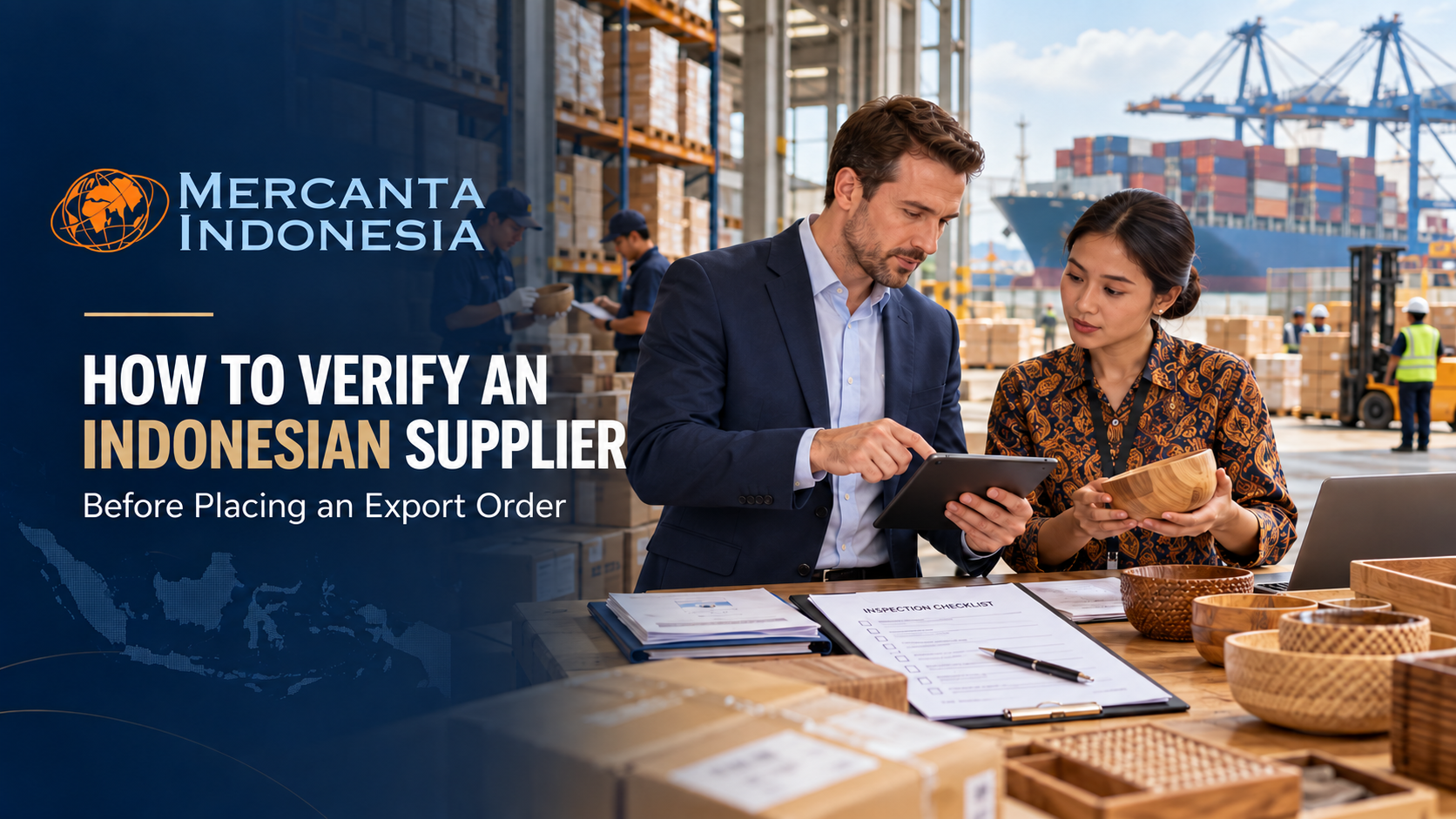
How to Verify an Indonesian Supplier Before Placing an Export Order
Supplier verification helps international buyers reduce quality, payment, production, and delivery risks. This practical guide explains the essential checks to complete before placing an export order with an Indonesian supplier.
How to Verify an Indonesian Supplier Before Placing an Export Order
Indonesia offers international buyers access to a wide range of products, including furniture, handicrafts, textiles, processed foods, coffee, spices, coconut products, beauty ingredients, industrial components, and private-label goods.
However, identifying an attractive product is only the beginning. Before placing an export order, buyers should confirm that the supplier is legally established, operationally capable, financially reliable, and able to meet the required quality and delivery standards.
A professional supplier-verification process does not imply distrust. It creates a stronger foundation for communication, reduces misunderstandings, and helps both parties build a sustainable commercial relationship.
Why Supplier Verification Matters
International sourcing involves distance, different legal systems, language differences, unfamiliar business practices, and longer logistics chains. If a supplier is not properly evaluated, a buyer may face:
• Inconsistent product quality • Production delays • Incorrect specifications • Missing export documents • Unapproved subcontracting • Payment fraud • Packaging failures • Certification problems • Missed shipping schedules • Difficulty recovering deposits
The level of verification should reflect the order value, product risk, customization requirements, and the length of the intended business relationship.
1. Confirm the Supplier’s Legal Identity
Begin by identifying the legal entity that will manufacture, sell, or export the goods.
Ask the supplier to provide relevant company information, such as:
• Registered company name • Business address • Business identification or registration number • Tax information where appropriate • Name and position of the authorized representative • Corporate email address • Bank-account beneficiary name • Factory or warehouse address • Relevant business licenses
The company name appearing on quotations, contracts, invoices, and bank information should be consistent. If different companies are involved in manufacturing, invoicing, or exporting, request a clear explanation of each party’s role.
A supplier using a trading name may still be legitimate, but the buyer should understand which legal entity will be contractually responsible for the transaction.
2. Verify the Physical Business Location
A website and professional product catalogue do not prove that a supplier operates from the stated address.
Verification may include:
• Checking the address through reliable mapping services • Conducting a live video call from the facility • Requesting recent photographs of production and storage areas • Arranging an on-site visit • Using an independent inspection or verification company • Confirming whether the location is a factory, office, warehouse, or residential address
During a live video tour, ask the supplier to show production equipment, raw materials, finished goods, packaging areas, quality-control activities, and warehouse conditions.
Pre-recorded videos can provide useful background information, but a live and interactive tour offers stronger verification.
3. Understand the Supplier’s Actual Role
Not every supplier is a manufacturer. Some companies are trading businesses, sourcing agents, consolidators, cooperatives, or exporters working with several producers.
These models can all provide value, but the supplier’s role should be transparent.
Ask:
• Do you manufacture the product directly? • Which production processes are completed internally? • Is any work subcontracted? • Who controls product quality? • Who owns the molds, designs, or product specifications? • Who will appear as the exporter? • Can the production location be inspected?
If subcontracting is required, the buyer should understand how the subcontractor is selected, supervised, and included in quality-control procedures.
4. Evaluate Production Capacity
A supplier may produce an excellent sample but lack the capacity to manufacture a full commercial order consistently.
Request information about:
• Normal monthly production capacity • Existing production commitments • Available machinery and workforce • Raw-material availability • Minimum order quantity • Production lead time • Peak-season constraints • Packaging capacity • Quality-control personnel • Contingency arrangements
Production capacity should be evaluated against the required quantity and delivery schedule. Buyers should be cautious when a supplier promises unusually large volumes or extremely short lead times without explaining how the order will be managed.
5. Review Product Experience
A supplier with relevant product experience is more likely to understand material selection, production risks, testing requirements, packaging needs, and common defects.
Ask for:
• Product catalogues • Technical specifications • Material descriptions • Export-market experience • Examples of similar products • Available test reports • Relevant certifications • Packaging specifications • References where appropriate
Certification documents should be checked for the correct company name, scope, issuing body, validity period, and product coverage.
A certificate should not be accepted solely because a logo appears on a scanned document. Where possible, confirm its validity with the issuing or certification organization.
6. Request and Approve Samples
Samples allow the buyer to evaluate the supplier’s product quality before committing to a larger order.
The sample-review process should cover:
• Dimensions • Materials • Color • Weight • Construction • Function • Finish • Labeling • Packaging • Performance • Acceptable tolerances
Once approved, the sample should become a documented reference for production. Photographs, measurements, specifications, and approval records should be retained by both parties.
Buyers should remember that a high-quality sample does not automatically guarantee consistent mass production. Production inspections may still be required.
7. Establish Written Product Specifications
General descriptions such as “high quality,” “export standard,” or “premium material” are open to interpretation.
Specifications should clearly state:
• Product dimensions and tolerances • Material composition • Grade or quality level • Color references • Performance requirements • Permitted and prohibited substances • Labeling requirements • Packaging configuration • Barcode or private-label requirements • Testing standards • Defect classifications • Acceptance criteria
The specifications should be included in the purchase order, contract, or approved technical document.
When the product is customized, ownership and permitted use of designs, molds, packaging artwork, trademarks, and confidential information should also be addressed.
8. Check Quality-Control Systems
Ask the supplier how quality is managed from raw-material receipt to final shipment.
A suitable quality-control system may include:
• Incoming-material inspection • Approved reference samples • In-process inspections • Batch or production records • Final random inspection • Defect classification • Traceability procedures • Corrective-action records • Packaging inspection • Container-loading supervision
For higher-value, regulated, customized, or quality-sensitive orders, consider using an independent inspection company.
The inspection scope should be agreed before production and may include quantity, workmanship, dimensions, function, labeling, packaging, and shipping marks.
9. Review Export Capability
A capable manufacturer may not necessarily have sufficient export experience.
Confirm whether the supplier understands:
• Commercial invoices • Packing lists • Certificates of origin • Bills of lading or airway bills • Export declarations • Product-specific certificates • HS-code coordination • Incoterms • Freight-forwarder communication • Destination-country requirements
The buyer and supplier should agree on who will prepare each document and who will verify its accuracy.
Incorrect or inconsistent documentation can delay customs clearance even when the product itself is acceptable.
10. Conduct Commercial and Payment Checks
Review whether the commercial offer is complete and realistic.
The quotation should clearly state:
• Product description • Unit price • Currency • Minimum order quantity • Incoterm and named place • Payment schedule • Production lead time • Quotation validity • Packaging details • Inspection arrangements • Shipping-document requirements
Verify bank information through a separate and reliable communication channel before transferring funds.
The beneficiary name should normally correspond with the contracted legal entity. Any request to pay an unrelated third party or a recently changed bank account should be investigated carefully.
For a new relationship, buyers may consider a manageable trial order, staged payments, inspection-linked milestones, escrow, a letter of credit, or another suitable risk-control arrangement.
11. Check References and Transaction History
Where appropriate, ask for business references from customers, logistics partners, or other professional parties.
Useful questions may include:
• Did the supplier deliver on time? • Was product quality consistent? • Were documents accurate? • Did the supplier respond appropriately to problems? • Were repeat orders placed? • Were claims resolved professionally?
References should be treated as one part of the verification process rather than conclusive proof.
12. Start With a Controlled Trial Order
A trial order allows both parties to test the complete transaction process before increasing volume.
The trial should evaluate:
• Communication speed and accuracy • Sample-to-production consistency • Production scheduling • Inspection results • Packaging quality • Documentation accuracy • Shipping coordination • Delivery performance • Response to corrective actions
A successful trial order creates practical evidence that can support a longer-term relationship.
Supplier Verification Checklist
Before placing an export order, confirm that:
• The legal company identity has been reviewed. • The business and production addresses have been checked. • The supplier’s role is clearly understood. • Production capacity is realistic. • Product experience is relevant. • Samples have been reviewed and approved. • Written specifications are complete. • Quality-control procedures are established. • Certifications have been checked where required. • Export-document responsibilities are clear. • Payment instructions have been independently verified. • Inspection requirements are documented. • Intellectual-property and confidentiality terms are addressed. • The contract includes clear commercial terms. • A trial order has been considered for a new relationship.
How Mercanta Indonesia Can Help
Mercanta Indonesia supports international buyers seeking reliable products and sourcing partners in Indonesia.
Depending on the agreed scope, our support may include:
• Identifying potential Indonesian suppliers • Conducting preliminary supplier screening • Coordinating company and product information • Arranging samples • Clarifying buyer specifications • Supporting quotation comparisons • Coordinating factory visits or virtual meetings • Assisting with inspection arrangements • Supporting documentation and logistics communication • Monitoring important transaction stages • Maintaining appropriate confidentiality between parties
Our role is to help buyers and suppliers communicate more clearly, identify risks earlier, and develop commercially sustainable relationships.
Conclusion
Supplier verification is not a single document or background check. It is a structured process covering legal identity, physical operations, production capability, product quality, export readiness, commercial terms, and payment security.
No verification process can eliminate every risk. However, careful due diligence, clear specifications, independent checks, and a controlled first order can significantly reduce preventable problems.
Looking for reliable Indonesian products or a structured sourcing process?
Contact Mercanta Indonesia to discuss your product requirements and explore sourcing opportunities from Indonesia.
Mercanta Indonesia — Connecting Indonesian Products with Global Markets.
Disclaimer: This article provides general business information and does not constitute legal, financial, tax, customs, certification, or regulatory advice. Buyers should conduct transaction-specific due diligence and consult qualified professionals where appropriate.